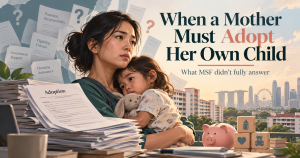
MSF’s statement on unwed parents is technically correct, but narrowly framed. Here’s what the answer leaves out about Baby Bonus cash, tax relief, inheritance and housing.
I was reading CNA’s recent article, “‘I gave birth to her, so why do I have to adopt her?’: The unwed single parents adopting their own children”, and one part of the Government’s response immediately bothered me.
MSF told CNA:
“Unwed parents do not need to adopt their biological children to qualify for government benefits that are extended regardless of parental marital status.”
Technically, that statement is true.
But read the last part again:
“…benefits that are extended regardless of parental marital status.”
That qualifier is doing a lot of work.
Because the real question was never whether unwed mothers receive nothing.
The real question is whether adopting their own biological child can remove disadvantages that exist precisely because they were not married when the child was born.
And the answer to that is clearly yes.
Why would a mother adopt a child she gave birth to?
That was my first question.
If adoption makes no meaningful difference, why are mothers spending thousands of dollars, going through assessments, home visits, paperwork and court proceedings just to “adopt” a child they carried, delivered and have already been raising?
Nobody does that for fun.
CNA reported that one mother spent about S$6,000 and roughly 18 months completing the process. The article also explains that biological parents adopting their own child are subject to the same core pre-adoption requirements as unrelated prospective adopters, including an Adoption Suitability Assessment, interviews, home visits and a court application.
That should immediately tell us that something more complicated is going on.
MSF’s answer is technically correct — but incomplete
To be fair, Singapore does provide many important forms of support to Singaporean children regardless of whether their parents are married.
MSF has said that benefits supporting a child’s growth and development are available regardless of parental marital status, and points to financial assistance, counselling and parenting support. Its earlier policy explanations also cite areas such as education, healthcare and childcare support.
So no, an unwed mother does not need to adopt her child just so the child can see a doctor, attend subsidised childcare or receive basic state support.
That part matters.
But it is not the whole story.
Baby Bonus: the wording matters
The most obvious example is the Baby Bonus.
LifeSG’s eligibility rules make an important distinction between different components of the scheme.
Children of never-married single parents can qualify for Child Development Account benefits.
But LifeSG also states:
“Parents must be lawfully married to qualify for the Baby Bonus Cash Gift.”
That means a statement such as “unwed parents can receive Baby Bonus benefits” can be technically correct while still hiding an important distinction.
They may receive the CDA component.
They do not necessarily receive the same Baby Bonus Cash Gift available to married parents.
CNA highlighted exactly this point in the case of one mother whose child was not eligible for the S$11,000 cash gift.
So when MSF says adoption is unnecessary for benefits that are already available regardless of marital status, that is true almost by definition.
What the answer does not address is the set of benefits where marital status does matter.
Tax relief is another example
CNA reports that unwed mothers who adopt their biological children can become eligible for the S$4,000 Qualifying Child Relief.
IRAS’s published rules tie the relief to specific legal parent-child relationships, including legally adopted children.
That creates a bizarre situation.
A woman can:
- carry the child,
- give birth to the child,
- raise the child,
- support the child financially,
- and be legally responsible for the child,
yet formal adoption can still change her eligibility for a tax relief intended to recognise the cost of supporting a child.
Meanwhile, other benefits such as the Working Mother’s Child Relief remain restricted to mothers who are married, divorced or widowed.
Again: MSF’s statement is not false.
It is simply answering a narrower question than the one many readers thought was being asked.
Inheritance may be an even bigger reason
For some mothers, this is not really about receiving money from the Government at all.
It is about making sure their child is legally protected if they die.
CNA spoke to mothers who pursued adoption partly because of inheritance concerns.
Singapore’s intestacy framework still contains legal distinctions relating to legitimacy, while adoption changes the child’s legal status.
A mother can of course write a will and undertake proper estate planning.
But that does not erase the underlying point:
without additional legal steps, the child’s position is not necessarily identical to that of a child born within marriage.
That is a meaningful difference.
Housing is another gap
CNA also reports that unwed parents and their children are not treated in the same way as married, divorced or widowed parent-child households under ordinary HDB family-nucleus rules.
This can affect access to:
- family-tier BTO flats,
- family housing grants,
- priority balloting schemes,
- and subsidised interim housing.
Appeals may be considered on a case-by-case basis, but that is not the same thing as having the entitlement in the first place.
So let’s ask the more useful question:
Are an unmarried mother and her biological child treated identically to a married mother and her biological child?
No.
And MSF itself effectively acknowledges this.
CNA quotes the ministry as saying:
“Where certain benefits or laws differentiate based on marital status, these reflect the government’s longstanding policy of supporting parenthood within marriage.”
That, to me, is the much more meaningful answer.
Supporting marriage is fine. But what about the child?
I understand the policy instinct.
Singapore wants to encourage marriage, stable families and two-parent households.
Most people would probably agree that, all else being equal, a stable and loving family environment is a good thing.
But life is not always cooperative.
Relationships fail.
People leave.
Some pregnancies happen in circumstances nobody planned.
Sometimes marrying the other parent would actually make life worse, not better.
I know unwed mothers personally.
I doubt any of them grew up thinking:
“My dream is to raise a child alone.”
Most would have preferred the neat version of life too — partner, marriage, children, stable home.
But sometimes life gives you lemons.
And when that happens, the mother still gets up every morning, feeds the child, sends the child to school, pays the bills and does the parenting.
The child still grows up Singaporean.
The child is still part of Singapore’s future.
The child did not choose any of this
This is the part I struggle with the most.
Singapore is facing an ageing population and persistently low birth rates.
We spend enormous amounts of policy energy trying to encourage Singaporeans to have children.
Then a child is actually born.
A real child.
One who will grow up, go to school, work, pay taxes and hopefully build a life here.
Why should that child carry a different legal or financial status because his or her parents were not married?
The child did not make that decision.
The child did not fail to register a marriage.
The child did not choose the circumstances of conception.
So even if we accept that Government policy should encourage marriage, I think it is fair to ask whether the child should be the place where that policy difference is felt.
Those are not the same thing.
And then we arrive at the strangest part
A biological mother may decide that the best way to close some of these gaps is to legally adopt her own child.
Pause on that for a moment.
She is not applying to become the child’s mother.
She already is the mother.
She carried the child.
She gave birth to the child.
She may have raised the child alone from day one.
Yet she can still end up going through an adoption process — complete with assessments, paperwork, home visits and court proceedings — to improve the legal status of that very same child.
There are legitimate legal reasons why adoption cannot simply be a rubber stamp. It can affect the biological father’s parental rights and responsibilities, including maintenance obligations.
Those consequences deserve proper legal scrutiny.
But that does not make the situation any less strange from the mother’s point of view.
So was MSF wrong?
I would not say MSF lied.
I would not even say the statement was factually incorrect.
I would say it was technically correct, but incomplete in a way that matters.
MSF answered:
Do unwed parents need to adopt their children to obtain benefits that are already available regardless of marital status?
No.
But the question many readers are actually asking is:
Can adopting their biological child give an unwed parent or child access to rights, benefits or legal treatment they otherwise would not have?
Based on CNA’s reporting and the Government’s own published rules, the answer is yes.
That includes differences involving:
- the Baby Bonus Cash Gift,
- tax relief,
- inheritance,
- housing,
- and the broader legal status of the child.
So perhaps the better question is not:
“Do unwed mothers need to adopt their own children to receive government benefits?”
The better question is:
“Why does adopting their own biological child improve their position at all?”
And one level deeper:
In a Singapore that says every child matters to our future, which of these distinctions still protect the child — and which simply preserve the consequences of the parents’ marital status?
Unwed mothers already have enough to carry.
We should be careful about making the child carry the rest.
This article is commentary based on publicly available information and CNA’s reporting. It is not legal advice. Adoption, succession, housing and family-law outcomes can vary according to individual circumstances.
Sources