Singapore’s Beverage Container Return Scheme (BCRS) has a worthwhile objective: increase the recovery and recycling of beverage containers by putting a refundable 10-cent deposit on regulated cans and bottles.
But as the scheme moves towards full implementation, there is another public interest worth protecting alongside recycling: consumer choice and competition.
In particular, will smaller beverage importers — including the parallel importers that bring Singapore consumers cheaper alternatives, niche brands, unusual flavours and limited-edition products — be able to comply with BCRS as easily and economically as the largest beverage producers?
This question deserves particular attention because BCRS Ltd is itself industry-led.
The National Environment Agency describes BCRS as a "producer-led Scheme". BCRS Ltd’s board comprises Coca-Cola Singapore Beverages, F&N Foods, Pokka, Wanin Industries and Chia Khim Lee Food Industries.
There is nothing inherently wrong with an industry-led scheme. Producers have the technical expertise and, under Extended Producer Responsibility, are supposed to bear responsibility for the waste created by their products.
But BCRS is also mandatory.
From 1 October 2026, regulated beverage products supplied in Singapore must carry the BCRS Deposit Mark, and the 10-cent deposit applies to regulated containers.
That makes the accessibility, cost and neutrality of the compliance process important not merely to beverage companies, but ultimately to Singapore consumers.
One scheme, three very different economies of scale
Consider three hypothetical businesses selling exactly the same category of beverage.
The numbers below are illustrative rather than quotations of what any particular company pays. Their purpose is to demonstrate why the same regulatory requirement can have very different commercial consequences at different scales.
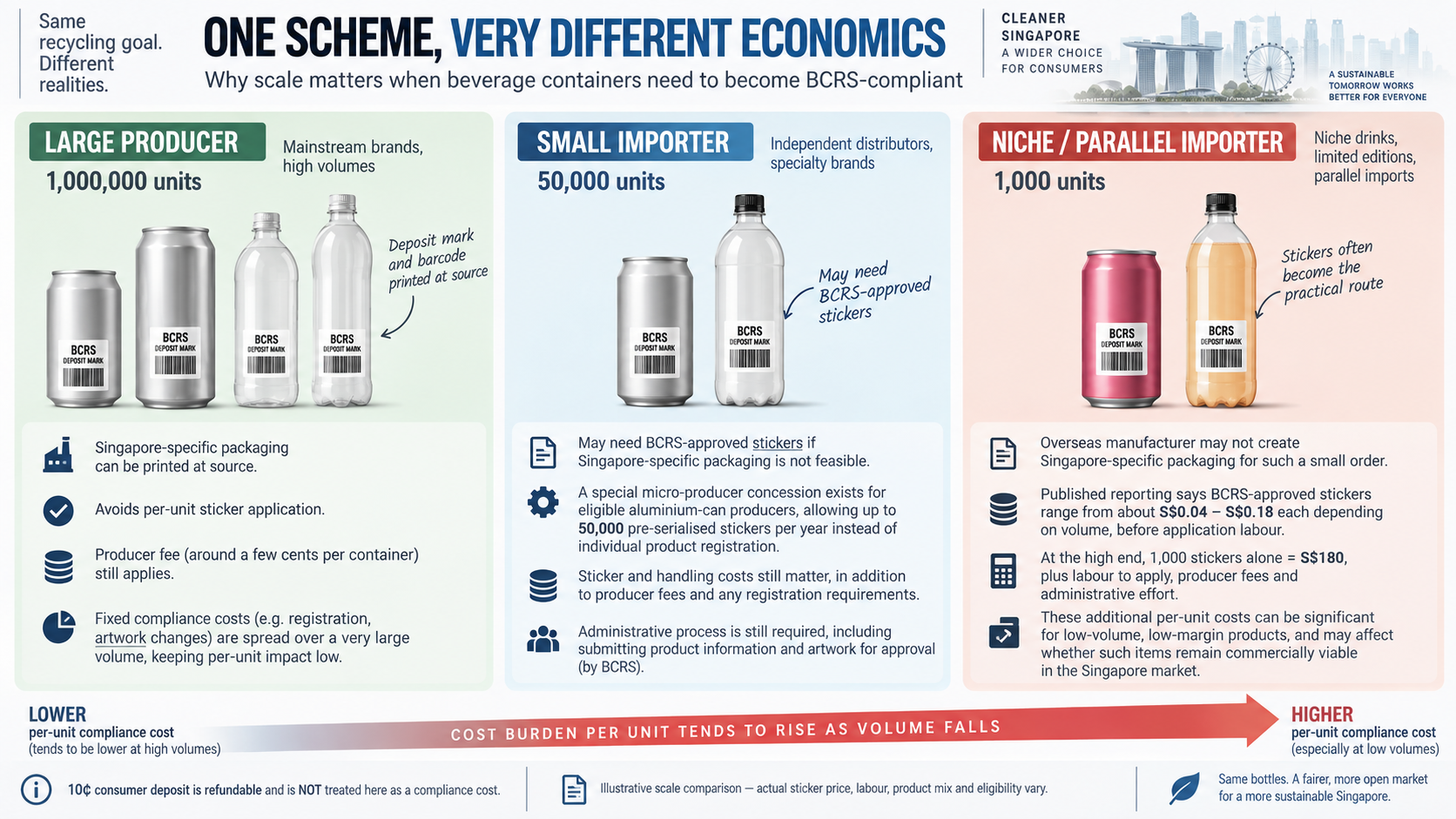 Illustrative comparison: the same BCRS obligation can produce very different per-unit economics depending on scale. The refundable 10-cent consumer deposit is not treated here as a compliance cost.
Producer A: 1,000,000 containers
Imagine a major beverage producer expecting to sell one million units of a product in Singapore.
At this scale, producing Singapore-specific packaging is commercially realistic. The deposit mark and appropriate barcode can potentially be incorporated into the packaging artwork before cans or bottles leave the production line.
There will still be BCRS producer fees, registration requirements, artwork changes and other implementation costs. But crucially, the company can potentially avoid buying and manually applying one million individual stickers.
Its fixed implementation costs are also spread over one million units. This is economies of scale doing exactly what economies of scale normally do.
Producer B: 50,000 containers
Now consider an independent distributor bringing in 50,000 cans.
Creating a Singapore-only production run may no longer be practical. The overseas manufacturer may have minimum production quantities far beyond what the Singapore importer can sell. Stickering therefore becomes considerably more relevant.
BCRS requires scheme stickers to be ordered through BCRS-appointed printing companies. Stickers from other printers are not accepted. BCRS states a printing lead time of approximately two to six weeks depending on quantity. If the importer wants the printer to perform the physical stickering as well, services can include opening cartons, removing products, applying the stickers and repacking them.
There has been a welcome development for some very small producers. Eligible micro-producers of aluminium cans can obtain up to 50,000 pre-serialised stickers annually instead of individually registering products.
That concession suggests that NEA and BCRS recognise the disproportionate administrative burden that product-by-product registration can impose at small scale.
But it also raises useful questions. Who qualifies? What happens to plastic-bottle importers? What happens when an importer carries many niche SKUs rather than large quantities of a few products? And what are the actual all-in sticker and handling costs after the available assistance ends?
Producer C: 1,000 containers
Finally, consider a parallel importer bringing just 1,000 units of a seasonal Japanese drink, a European craft soda or a limited-edition flavour.
Asking the foreign manufacturer to redesign its production packaging for 1,000 Singapore-bound cans is unlikely to be realistic. The importer therefore needs another route to BCRS compliance.
And this is where per-unit economics become important.
Published reporting has put BCRS-approved stickers at approximately 4 to 18 cents each depending on volume, before the labour required to apply them.
At the upper end of that reported range: 1,000 × $0.18 = $180 in stickers alone.
That is before someone opens the cartons, handles every container, applies every sticker and repacks them. It is also before the ordinary producer fee and administrative requirements.
The 10-cent consumer deposit should not be included in this comparison as though it were another compliance expense: the deposit is refundable to the consumer when the container is returned.
The sticker, handling and compliance expenses are different. Those are genuine costs associated with getting the product onto the Singapore market. For an inexpensive beverage with a thin importer margin, an additional ten or twenty cents per unit can matter considerably.
Same requirement, very different consequences
1,000,000 units: Singapore-specific packaging may be incorporated at the factory. Fixed implementation costs are spread across enormous volume.
50,000 units: Stickering may be necessary, although the micro-producer concession could substantially reduce registration friction for eligible aluminium-can producers.
1,000 units: Singapore-specific manufacturing is much less realistic, while sticker, labour and administrative costs are divided among very few units.
The environmental requirement is identical. The economics are not.
This doesn’t mean that BCRS is deliberately disadvantaging smaller competitors. There is no evidence presented here that it is.
NEA has also introduced a Producer Transition Grant of up to $2,500 to help producers with costs including registration fees, producer fees and scheme stickers. That is a positive acknowledgement that implementation costs can disproportionately affect smaller businesses. But temporary assistance doesn’t eliminate the longer-term question.
Why should consumers care about parallel importers?
It would be easy to treat this as an argument between beverage companies. It isn’t.
Parallel importers and independent distributors perform a useful competitive function in a small market such as Singapore. They can source products from other markets when doing so is commercially attractive. They also bring in products that an official distributor may decide are not worth launching locally: regional flavours, seasonal editions, specialist drinks and brands with relatively small followings.
The result for consumers is potentially more choice and more price competition.
If compliance imposes a relatively small cost on a mass-market beverage but a substantial per-unit cost on a low-volume import, some products may simply cease to be commercially worthwhile to bring into Singapore.
The consumer may never see a line item saying "BCRS compliance: 18 cents". Instead, the drink may become more expensive. Or the importer may decide not to import it at all.
That second outcome is arguably harder for consumers to notice. You cannot complain about the price of a product that quietly disappeared from the market.
The question isn’t whether BCRS should exist
Singapore needs better recycling outcomes, and a container-return system is a legitimate way of pursuing them.
Nor is this article suggesting that BCRS Ltd or the beverage companies involved in it have deliberately disadvantaged their competitors.
Singapore’s competition regulator has previously examined the establishment and operation of BCRS and concluded that the arrangement was unlikely to infringe sections 34 and 47 of the Competition Act.
But regulatory compliance and good governance are not quite the same question as public confidence.
When participation in a national scheme is compulsory, and the organisation administering that scheme was established by major participants in the same industry, transparency becomes particularly important.
Consumers and smaller competitors should be able to understand: How are sticker prices determined? Why must stickers come only from BCRS-appointed suppliers? How competitive was the process for appointing those suppliers? How quickly are products approved? What information about a competing product or importer is visible to BCRS, its management and its board? What safeguards separate commercially sensitive information from companies represented on that board? What happens when a product is rejected? Is there an independent avenue of appeal? And does BCRS monitor whether its requirements are causing low-volume products to disappear from Singapore?
These aren’t accusations. They are questions that become reasonable whenever an industry-led organisation is entrusted with administering a mandatory national scheme affecting every competitor in that industry.
Recycling without sacrificing competition
There need not be a choice between recycling and competition. A successful BCRS should be capable of achieving both.
If technology eventually allows small importers to obtain compliant labels more cheaply, approval becomes faster, administrative requirements are simplified and micro-producer concessions are expanded where evidence shows they are needed, that should be celebrated.
But the measure of the scheme’s success should not simply be the number of containers returned.
We should also ask whether Singapore reached that environmental objective without unnecessarily making it harder for small businesses to compete or reducing the range of products available to consumers.
A million-can producer and a thousand-can importer may both be subject to exactly the same environmental obligation.
Making sure that obligation does not inadvertently become a barrier to competition is precisely why transparency matters.
Sources include the National Environment Agency, BCRS Ltd, the Competition and Consumer Commission of Singapore, and published reporting by CNA. Cost examples in this article are illustrative and should not be interpreted as the actual costs incurred by any named company.