📢 Update @ 29 May 2026
This story has since been covered by Zaobao and Must Share News, with both reports picking up on the Amazon OTP delivery failure and the consumer-protection questions around high-value deliveries marked as completed without the parcel ever reaching the customer.
📢 Update @ 27 May 2026
Someone from Amazon’s Executive Relations team has since reached out to me and assured me that the matter is now being immediately investigated, including the conduct of the driver involved. I was also informed that a refund and goodwill compensation would be arranged for the experience.
I’ve replied to request visibility into the investigation outcome — even offering to sign an NDA if necessary — because after almost a month of uncertainty, contradictory responses, missed callbacks and a police report, I genuinely just want closure and to understand what actually happened.
Thank you to everyone who followed, shared advice, offered support, or simply amplified the story. I honestly wish I never had to embark on this journey in the first place, but I hope the discussion around OTP-based deliveries and consumer safeguards proves useful to others.
I was home. I was waiting. I was ready.
On 28 April 2026, I was expecting an Amazon delivery — an Acer laptop, S$1,499, ordered the day before. Amazon had told me it required OTP verification. You know the drill: driver arrives, you give them a six-digit code, they hand you the box. Supposed to be more secure than leaving a package at the door.
At 9:03 AM that morning, Amazon emailed me:
“Arriving Today: A one-time password is required for your Amazon delivery.” Great, I thought — extra security for a big-ticket item.
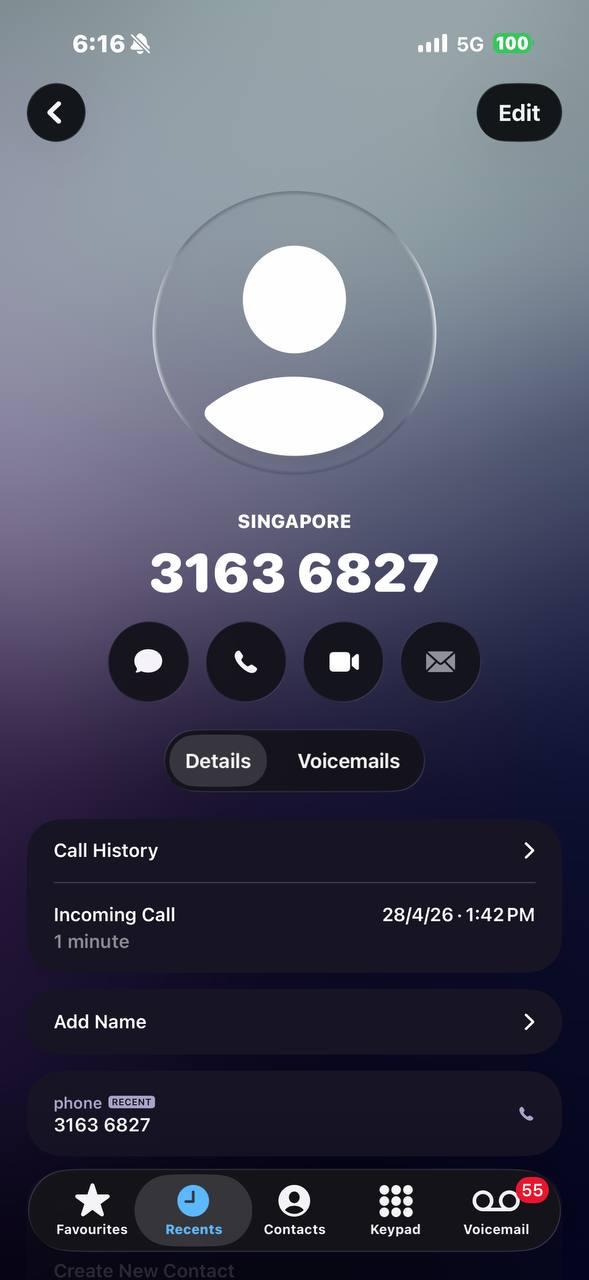
At 1:42 PM, my phone rang. Local number. Caller ID: 3163 6827.
(Update: This is a VALID Amazon Logistics number!)
“Hi, I’m your Amazon delivery driver. I need your OTP to complete the delivery.”
I gave it to him. Why wouldn’t I? Amazon had literally emailed me four hours earlier telling me a driver would need my OTP. This was also my very first Amazon order that required OTP — I had no prior experience with the process, and nothing in the email made it obvious that a phone call was a red flag.
The call ended. My Amazon app updated:
“Delivered.”
Nobody came to my door.
The call that started it all — 1:42 PM, 28 April 2026. Caller ID: 3163 6827.
The Part Where It Gets Worse
I checked my IP camera. I checked my smart doorbell. I reviewed the footage thoroughly. No driver, no delivery person anywhere near my unit at the time of the call.
I contacted Amazon immediately.
Amazon’s own customer service confirmed two things:
- There was no delivery photo or proof of delivery recorded for my order — their own SOP requires drivers to photograph the package at the recipient’s door
- OTPs are only supposed to be provided in person, at the point of delivery, entered directly into the driver’s device
So to recap: their driver (or someone claiming to be their driver) called me, asked for the OTP over the phone, used it to mark the package as delivered, and never showed up. Amazon’s system accepted the OTP without any delivery proof. At 1:44 PM, Amazon sent a “Delivered” email claiming
“Parcel was handed to resident” — a statement their own system generated automatically, despite no delivery actually taking place.
And now I’m the one out S$1,499.
The Number That Called Me
+65 3163 6827. It’s a Singapore VoIP number. While it’s normal for delivery companies to use VoIP or in-app calling to reach customers, what’s not normal is what happened next.
And think about this: how did the caller know I had an Amazon delivery that day? How did they know it required an OTP? How did they know the exact delivery window? A random scammer doesn’t have access to Amazon’s internal delivery schedule. And even if someone tricked me into giving them the OTP over the phone — the OTP alone doesn’t make a physical laptop vanish from Amazon’s warehouse. Someone with access to Amazon’s logistics chain had to physically intercept the package.
OTP fraud explains how the delivery was falsified. But only someone inside Amazon’s delivery operation could make the box disappear.
Enter Amazon’s “Leadership Team”
I filed a police report on 30 April (F/20260430/7***, assigned to Ang Mo Kio Division HQ). I then called Amazon and demanded escalation. I was connected to a supervisor named Kyle, who identified himself as being from the “Amazon Singapore Leadership Team.”
During this phone call, Kyle advised me to place a replacement order for the same laptop — the replacement order. He said the investigation and refund would take time, and ordering a replacement was the fastest way to get my laptop. So I did, right there on the call with him.
Let that sink in: if Amazon truly believed the original delivery was legitimate, why would their Leadership Team supervisor tell me to buy a second identical S$1,499 laptop? Why would anyone who just “received” a laptop need another one?
After the call, Kyle sent a follow-up email. He said he had “set a follow-up on my account” and “raised this issue to the relevant team.” He asked for “2 business days to get an update.”
On 2 May, Kyle emailed again. He said the specialist team was “coordinating with Logistics” and — I quote —
“discussing the best possible compensation we can offer.”
That was 2 May. I never heard from Kyle again.
I chased on 5 May. Nothing.
I chased again on 7 May from a different email address. Nothing.
On 13 May, I called Amazon for an update. The agent I spoke to checked my case notes and told me Kyle was supposed to call me back on
15 May. “Please be patient,” he said.
15 May came and went. No call. No email. Nothing.
Today: The Mask Comes Off
Today is 23 May. My second Atome instalment for the laptop I never received is due soon. I decided to check on my case status again.
This time, Amazon’s attitude was completely different. The agent told me — coldly — that because I had given the OTP, it was
no longer Amazon’s responsibility. Case closed.
I demanded a supervisor immediately. I explained that Kyle was supposed to follow up with me. I asked them to stop passing judgement without actually investigating.
The supervisor who took over was curt. Kept repeating the same line: you gave the OTP, not our problem. And then —
she hung up on me.
Three weeks of silence. Two broken callback promises. A supervisor who literally hangs up on customers disputing a S$1,499 loss. This is Amazon Singapore’s idea of “customer service.”
The Part Where Amazon Blames You
Amazon’s position, when you strip away everything else:
“You gave away the OTP. That’s on you.”
Let’s lay out what Amazon did — and didn’t do:
- Amazon sent me an OTP email at 9:03 AM, priming me to expect a driver to ask for the code
- The one warning about not sharing the OTP over the phone was buried below the visible fold in the email — invisible on a mobile screen without scrolling past product details, tracking links, and delivery instructions
- This was my very first OTP order — a S$1,499 laptop, not a S$20 cable. Amazon threw a first-time OTP user into the deep end on a premium purchase
- Their system accepted the OTP remotely without requiring the driver to take a delivery photo — standard procedure that every other delivery driver follows
- Their system auto-generated a false statement: “Parcel was handed to resident”
- Their Leadership Team told me to buy a replacement laptop — implicitly acknowledging the first one was never received
- They promised compensation, then ghosted me for three weeks
- They promised a callback on 15 May — never happened
- When I finally pushed for answers, a supervisor hung up on me
Amazon has all the tools to investigate this: chat logs, call recordings, driver GPS data, which driver account redeemed the OTP, whether the caller number matches the assigned driver. They could determine exactly what happened. They have chosen not to.
What I’ve Done So Far
- Filed a police report within 48 hours (F/20260430/7***, assigned to Ang Mo Kio Division HQ)
- Contacted Amazon repeatedly across chat, phone, and email over nearly four weeks
- Escalated to their self-declared Leadership Team (who then ghosted me)
- Contacted Atome (my BNPL provider) — they said “pursue merchant resolution first”
- Saved every email, call log, and screenshot
I’m not letting this go. S$1,499 isn’t pocket change, and even if it were — the principle matters. Companies don’t get to design insecure systems, bury the safety warnings, generate false delivery claims, and then hang up on customers who try to hold them accountable.
What You Should Know
If you’re waiting for an Amazon OTP delivery:
- The driver should never ask for your OTP over the phone. Ever. If someone calls asking for it, they’re not your driver.
- Don’t hand over the code until you see the box and the driver at your door. That’s literally the point of OTP.
- If you’re scammed, file a police report immediately. Amazon will drag things out, and evidence degrades.
- Know that Amazon will try to blame you. Their go-to move is “you gave the OTP, case closed.” Don’t accept it.
Amazon’s OTP system is only as secure as the process around it. Right now, that process has a gap big enough to drive a delivery van through — assuming the van actually shows up.
Police report filed: F/20260430/7***. This post will be updated as the case develops.